
Migrating From Bubble to Custom Apps With iTitans
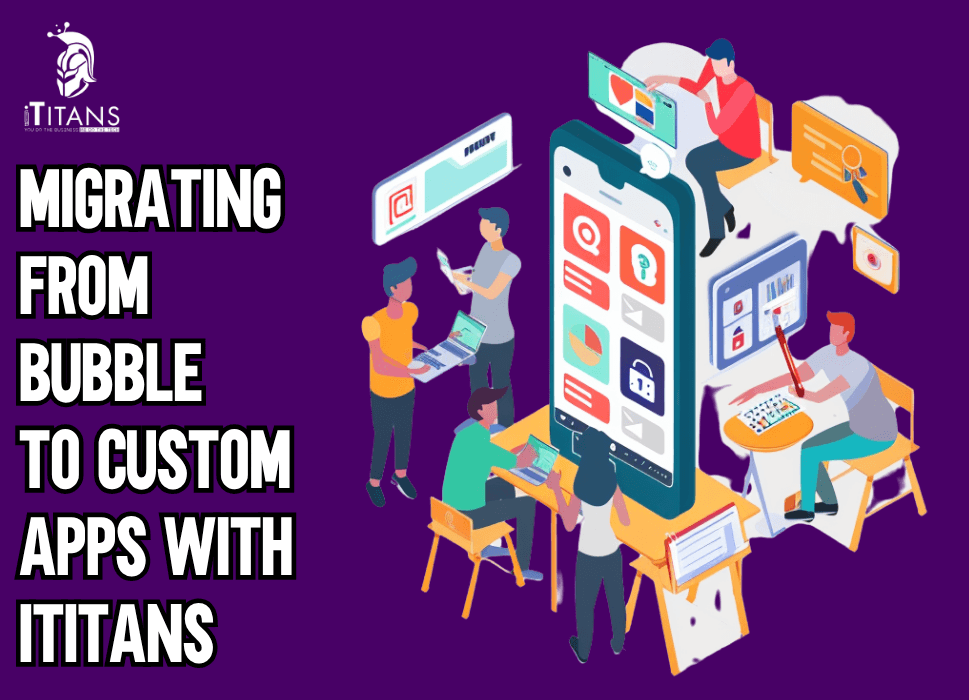
Many startups begin their journey with Bubble because it offers speed and lower upfront costs. It is an excellent choice for validating ideas and building MVPs without a large engineering team. However, growth changes the equation.
As products gain users, integrations become more complex, and performance expectations increase, founders often discover that no-code platforms come with limitations that affect expansion.
Bubble to custom app migration becomes less about replacing technology and more about creating a stronger foundation for long-term growth.
This is where iTitans helps businesses move beyond platform constraints and build applications designed around their future goals.
Why So Many Startups Choose Bubble
Bubble changed the way entrepreneurs launch products. For early-stage founders, the appeal is obvious. Instead of investing months and significant capital into development, they can create an MVP quickly and test product-market fit.
The ability to build without writing code has enabled thousands of startups to reach their first customers. Features that once required experienced engineers can now be assembled visually. This speed often makes the difference between validating an idea and watching an opportunity disappear.
Faster Time to Market
In competitive industries, speed matters. Bubble allows businesses to release products in weeks rather than months. This makes experimentation easier and reduces initial investment.
For many founders, Bubble represents a practical stepping stone rather than a permanent destination.
Lower Initial Development Costs
Hiring developers, product designers, and architects can quickly become expensive. Bubble gives startups an opportunity to launch without assembling a full engineering department.
During the early phase, this approach makes financial sense. Spending heavily before confirming market demand creates unnecessary risk.
A Powerful Environment for MVP Validation
Bubble shines when startups need to prove demand. Features can be added quickly, workflows can change rapidly, and feedback loops become shorter.
However, success introduces new challenges.
The same system that helped launch the business can eventually become the factor holding it back.
When Growth Becomes a Problem
At first, many teams don’t notice limitations. As traffic increases and customer expectations rise, issues begin to surface. Workarounds multiply, performance slows down, and maintaining workflows becomes increasingly difficult.
This is usually the stage where founders begin exploring move from Bubble to custom development solutions.
The question is no longer whether Bubble works.
The question becomes whether Bubble can support the next stage of growth.
Signs Your Business Has Outgrown Bubble
Understanding when to leave Bubble is critical. Waiting too long often results in higher costs and technical complications.
Performance Is Starting to Decline
One of the most common complaints involves speed.
As workflows become more complicated and databases grow larger, applications often experience delays. Slow page loading and inefficient backend processes begin affecting user experience.
Businesses that depend on customer retention cannot afford performance bottlenecks.
This is why many companies investigate Bubble scalability issues and solutions before deciding on migration.
Complex Workflows Have Become Difficult to Manage
No-code environments work well for straightforward functionality. But products evolve.
User roles expand.
Permissions become more sophisticated.
Third-party systems require deeper integrations.
What started as a clean visual architecture slowly turns into a network of dependencies that becomes harder to maintain.
Eventually, every new feature introduces additional risk.
Third-Party Integrations Create Friction
Modern businesses rely heavily on APIs.
Payment gateways, CRM systems, analytics platforms, ERP solutions, and AI tools all need to communicate with one another.
While Bubble supports integrations, many businesses discover limitations when attempting advanced implementations.
Custom applications provide complete control over APIs and backend architecture.
This flexibility becomes increasingly valuable as operations expand.
Security and Compliance Requirements Increase
Growing companies face new responsibilities.
Customer information must be protected.
Access controls become stricter.
Regulatory requirements become more demanding.
Although Bubble provides security measures, industries such as healthcare, fintech, and enterprise SaaS often require a greater level of control.
This is one reason why businesses begin considering custom app development after Bubble.
Vendor Dependence Creates Long-Term Concerns
Every startup wants ownership.
Founders want the freedom to adapt their products without being tied to the limitations of a platform.
As products mature, dependence on a single ecosystem creates strategic risks.
Pricing changes.
Feature limitations.
Infrastructure restrictions.
These factors can influence the future direction of a business.
Many founders eventually ask themselves a difficult question:
What happens if the platform no longer aligns with our vision?
That question alone has driven countless businesses toward Bubble app redevelopment.
The Hidden Cost of Staying Too Long
Most founders evaluate migration based on immediate costs.
What they often overlook is the cost of postponing migration.
Technical Debt Continues to Grow
Workarounds seem harmless initially.
A plugin here.
An extra workflow there.
Another external service added later.
Over time, these temporary fixes create complexity that becomes harder to manage.
Eventually, development slows and simple changes require significantly more effort.
The business starts paying an invisible tax.
Customer Experience Begins to Suffer
Users rarely complain about architecture.
They complain about outcomes.
Pages load slowly.
Features break unexpectedly.
Processes feel inconsistent.
In today’s environment, customers have little patience.
Poor experiences increase churn and reduce trust.
For SaaS companies, this directly affects revenue.
Expansion Becomes Increasingly Expensive
Ironically, staying on Bubble for too long can become more costly than migration itself.
Teams spend countless hours maintaining workarounds instead of building new capabilities.
Engineering efforts become reactive rather than strategic.
As competitors continue improving their products, businesses stuck managing technical limitations struggle to keep pace.
Why Startups Are Turning Toward Custom Development
The shift toward custom applications isn’t driven by trends.
It is driven by necessity.
Businesses reaching growth stages need greater control over performance, infrastructure, integrations, and user experience.
This explains the rising demand for Bubble migration services and the increasing interest in Bubble vs custom software development comparisons.
Founders who once prioritized speed now prioritize ownership.
Product leaders who initially chose convenience now seek flexibility.
And companies preparing for long-term expansion recognize that technology decisions made during the MVP stage should not dictate the future of the business.
For many organizations, migrating to custom software is not about abandoning Bubble.
It is about building the next chapter on stronger foundations.
Bubble vs Custom Software Development: Understanding the Trade-Offs
At some stage, almost every growing startup faces the same debate.
Should we continue adding workarounds inside Bubble, or should we invest in a system built specifically for our business?
The answer depends on where the company is today and where leadership expects it to be in the next three to five years.
The discussion around Bubble vs custom software development is not about declaring one approach universally better than the other. Both serve different purposes.
Bubble excels at rapid experimentation.
Custom software excels when products become serious business assets.
Ownership Changes Everything
One of the biggest advantages of custom development is ownership.
Founders who choose custom applications own their source code, infrastructure decisions, and product roadmap. They are not limited by a third-party platform’s priorities or ecosystem restrictions.
As businesses grow, this independence becomes increasingly valuable.
Instead of asking whether a platform supports a feature, companies can focus on whether the feature creates value for customers.
This distinction matters.
Especially when product differentiation becomes a competitive advantage.
Performance Matters More Than Ever
Customers expect fast applications.
They expect instant responses, smooth experiences, and consistent reliability.
While Bubble can handle many workloads, businesses experiencing rapid growth often encounter performance challenges that affect user satisfaction.
Custom applications built using React, Node.js, Laravel, or other modern technologies provide greater control over application performance and backend optimization.
This is one reason many SaaS companies begin exploring Bubble alternatives for scaling startups.
Greater Flexibility for Future Expansion
Startups rarely remain the same.
A product that began with a few features may eventually require:
- AI capabilities.
- Complex permissions.
- Multi-tenant architecture.
- Enterprise integrations.
- Regional databases.
- Mobile applications.
- Customer portals.
Custom software allows businesses to evolve without being constrained by platform limitations.
Instead of adapting their strategy to technology, companies can build technology around their strategy.
Benefits of Migrating to a Custom Application
Companies considering how to move a Bubble app to custom development are often motivated by one thing.
They want room to grow without compromise.
Better User Experience
User experience directly impacts customer retention.
A few extra seconds of loading time or a confusing workflow can lead to lost customers.
Custom applications provide complete control over interfaces, interactions, and performance.
This allows businesses to deliver experiences that align with their brand and customer expectations.
Stronger API and Third-Party Integrations
Modern businesses depend on dozens of tools.
CRM platforms.
Marketing systems.
Payment gateways.
AI services.
Inventory systems.
Analytics solutions.
Building these integrations inside Bubble sometimes requires plugins and workarounds.
Custom applications remove those limitations.
Businesses gain complete control over their APIs and data flows.
This becomes especially important when operations become more sophisticated.
Better SEO and Page Speed
Many founders overlook this advantage.
Search visibility increasingly depends on user experience and performance.
A custom web application using frameworks like Next.js offers advantages such as:
Faster Core Web Vitals
Search engines reward websites that deliver superior user experiences.
Faster loading times improve rankings and reduce bounce rates.
Better Indexing
Server-side rendering and optimized architecture help search engines understand content more efficiently.
Improved Mobile Experience
Mobile traffic now dominates many industries.
Fast, responsive applications contribute directly to better conversion rates.
These improvements are one reason businesses pursuing organic growth investigate no-code to custom development strategies.
Easier AI Integration
Artificial intelligence is rapidly changing how businesses operate.
Companies want to introduce:
- AI assistants.
- Recommendation engines.
- Predictive analytics.
- Workflow automation.
- Intelligent search.
Building advanced AI capabilities often requires deep backend control.
Custom software makes these integrations significantly easier.
As AI becomes more important, flexibility becomes a strategic advantage rather than a technical preference.
How iTitans Handles Bubble App Migration
Migration projects fail when businesses focus only on rewriting code.
Successful migrations require planning, communication, and a clear understanding of business priorities.
At iTitans, migration begins with understanding the product rather than immediately jumping into development.
Discovery and Architecture Planning
Before writing a single line of code, the team evaluates:
- Existing workflows.
- User journeys.
- Business logic.
- Integrations.
- Database structure.
- Future requirements.
This stage prevents unnecessary rework later.
More importantly, it helps avoid the problems many businesses experience after working with disconnected offshore teams.
Poor planning often leads to missed deadlines and budget overruns.
Architecture planning reduces those risks.
Database Migration
Data is one of the most valuable assets a company owns.
Users.
Transactions.
Customer records.
Analytics.
Historical information.
Protecting this data is critical.
Migration strategies are designed to preserve existing information while preparing databases for future growth.
For organizations researching Bubble to SaaS platform migration guide resources, database planning is usually one of the biggest concerns.
Frontend Development
Visual workflows inside Bubble are replaced with modern interfaces designed around performance and usability.
Technologies such as React and Next.js allow businesses to deliver faster and more responsive experiences.
The objective isn’t simply to recreate the old system.
The objective is to improve it.
Backend Development
Custom backends provide greater flexibility and control.
Depending on business requirements, iTitans uses technologies including:
Node.js
Ideal for applications requiring speed and real-time functionality.
Laravel
Popular among businesses seeking maintainability and structured architecture.
Python
Useful for AI applications, automation, and data-heavy platforms.
Backend systems are developed with future expansion in mind rather than focusing only on immediate requirements.
Integration and Testing
One of the most overlooked causes of software failure is insufficient testing.
Bugs.
Broken workflows.
Unexpected downtime.
Poor user experiences.
These issues can damage customer trust.
Before launch, applications undergo extensive testing to ensure every component performs as expected.
The goal isn’t merely to complete migration.
The goal is to create confidence.
Technologies Used for Modern Application Development
Businesses researching Bubble app to React and Node.js migration projects often want to know which technologies are involved.
The answer depends on business goals.
Common technologies include:
Frontend Frameworks
- React
- Next.js
- TypeScript
Backend Technologies
- Node.js
- Laravel
- Python
Databases
- PostgreSQL
- MongoDB
- MySQL
Cloud Infrastructure
- AWS
- Google Cloud
- Azure
Selecting the right stack depends on product requirements, expected traffic, security needs, and long-term objectives.
Technology decisions should support business growth rather than create future obstacles.
Cost of Migrating From Bubble to Custom Code
One of the first questions founders ask is about cost.
Naturally, leadership teams want to understand whether migration represents a financial burden or a strategic investment.
The truth is that the answer depends on several factors.
Companies searching for the cost of migrating from Bubble to custom code often expect a standard price, but migration projects vary significantly based on complexity.
Application Size
A small MVP with limited workflows requires far less effort than an enterprise SaaS platform serving thousands of users.
The number of screens, APIs, and business processes directly affects development time.
Database Complexity
Some applications contain years of customer information, payment records, and historical analytics.
Migrating this data safely requires planning and testing.
The larger the database, the greater the effort involved.
Third-Party Integrations
Payment systems, CRM platforms, AI tools, ERP software, and automation services all increase complexity.
Each integration requires careful implementation to ensure uninterrupted operations.
User Base and Traffic
Applications supporting large numbers of users require stronger infrastructure and performance optimization.
High-traffic systems often demand additional engineering considerations.
Rather than focusing solely on development expenses, businesses should evaluate the opportunity cost of remaining on a platform that limits future growth.
How Long Does Bubble Migration Take?
Another common question is:
How long does it take to migrate a Bubble app?
The answer depends on the product itself.
Small Applications
Simple applications with limited workflows may require four to eight weeks.
Mid-Sized SaaS Platforms
Products with multiple integrations and larger databases typically require two to four months.
Enterprise Systems
Applications supporting extensive business logic and thousands of users may take six months or longer.
Rushing migration often leads to expensive mistakes.
A structured approach minimizes disruptions and reduces long-term risk.
Common Reasons Why Bubble Migration Projects Fail
Not every migration succeeds.
In fact, many businesses come to iTitans after disappointing experiences with previous development partners.
Poor Communication
Communication breakdowns remain one of the biggest causes of software failures.
Founders become frustrated when teams disappear for days, misunderstand requirements, or deliver features that don’t match expectations.
Without clear collaboration, projects drift off course.
Weak Architecture Decisions
Shortcuts taken during the early stages often become expensive problems later.
Poor planning results in technical debt, unstable systems, and endless rework.
Many businesses spend more correcting bad decisions than they would have spent doing things properly from the beginning.
Unrealistic Timelines
Promising impossible deadlines may win projects, but those promises often lead to missed expectations.
Quality software requires planning, testing, and refinement.
Businesses should be cautious of development partners that guarantee unrealistic delivery schedules.
Focusing Only on Cost
Cheap development can become expensive.
Low-cost vendors frequently deliver inconsistent code quality, limited documentation, and systems that become difficult to maintain.
The result is a cycle of rebuilding and fixing problems instead of creating value.
Why Businesses Choose iTitans for Bubble Migration Services
Choosing the right development partner matters as much as choosing the right technology.
Many organizations seeking Bubble migration services have already experienced frustrations with outsourced teams.
Projects went over budget.
Deadlines slipped.
Communication suffered.
Code quality became an issue.
iTitans addresses these challenges by focusing on clarity, accountability, and long-term thinking.
Business-First Approach
Technology decisions should support business objectives.
Rather than forcing predefined solutions, iTitans evaluates:
- Product goals.
- Revenue models.
- Customer expectations.
- Expansion plans.
- Technical requirements.
This approach helps companies avoid costly mistakes.
Experienced Cross-Functional Teams
Successful applications require more than developers.
They require:
- Product thinkers.
- UI/UX specialists.
- Backend engineers.
- Frontend developers.
- QA professionals.
Bringing these disciplines together creates stronger outcomes.
Long-Term Partnership
Software development does not end after deployment.
Products evolve.
Markets change.
Customer expectations increase.
Ongoing support and continuous improvements help businesses remain competitive.
For many organizations, iTitans becomes a long-term technology partner rather than simply a development vendor.
Build Your Next Growth Stage With iTitans
Ready to move beyond Bubble? Contact iTitans today and discover how custom software can help your business grow with confidence.
FAQs
Can you migrate a Bubble app without disrupting existing users?
Yes, a Bubble app can be migrated gradually while keeping the current platform operational. This approach minimizes downtime and protects the user experience during the transition.
What is the biggest limitation of Bubble for growing startups?
The biggest limitation is flexibility. As applications become more complex, businesses often encounter performance issues, integration challenges, and restrictions that affect future development.
Should I rebuild my Bubble app or optimize it first?
If performance issues are minor, optimization may help. However, products experiencing long-term limitations and increasing technical complexity usually benefit more from a custom rebuild.
Which technologies are commonly used after leaving Bubble?
Many companies move to React, Next.js, Node.js, Laravel, or Python because these technologies provide greater control over performance, integrations, and future expansion.
Is migrating from Bubble to custom code expensive?
Migration costs depend on application size, database complexity, and third-party integrations. Although custom development requires investment, many businesses find it more cost-effective than maintaining growing limitations.
Can I keep my existing database and user accounts during migration?
Yes, customer data, authentication systems, and user records can usually be transferred to the new application through a structured migration process.
Why do SaaS companies move away from no-code platforms?
SaaS companies often outgrow no-code platforms when they need advanced functionality, stronger infrastructure, better performance, and complete ownership of their technology.
How do I know if my Bubble app has become too complex?
Frequent workarounds, slow performance, difficult maintenance, and increasing development costs are common signs that a Bubble application has outgrown its original platform.