
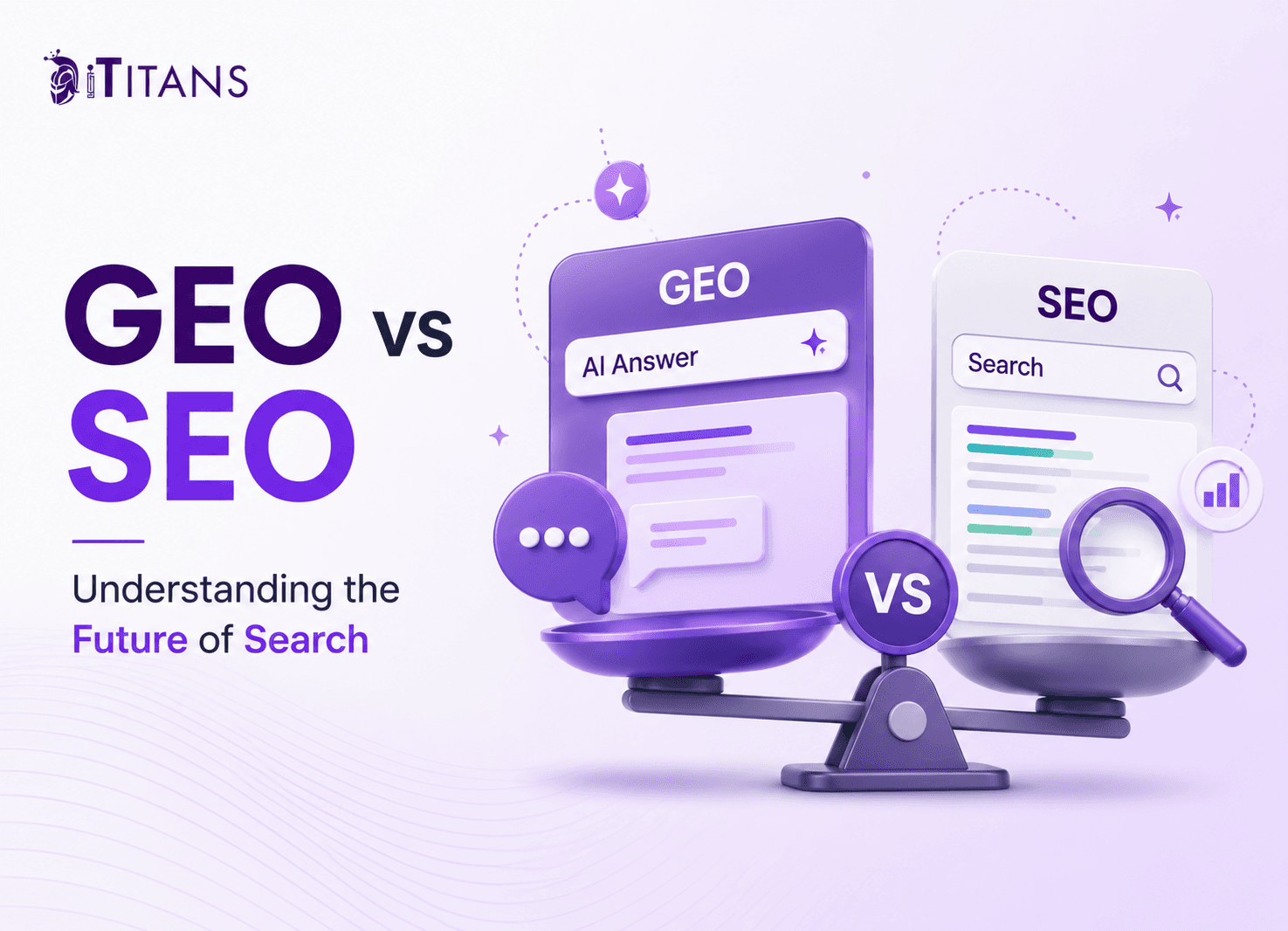
GEO vs SEO | Understanding the Future of Search
Search has changed more in the last two years than it did in the previous decade.
For years, businesses focused almost exclusively on rankings. The playbook was simple. Create pages, target keywords, earn backlinks, and climb Google’s search results. That approach still matters, but the arrival of AI-powered search experiences has introduced a new challenge.
Users are no longer limited to clicking blue links. They are asking questions directly to AI systems and receiving complete answers without ever visiting a traditional search results page.
This shift has sparked conversations around GEO vs SEO, raising an important question for founders, CTOs, product owners, and business leaders: are traditional search strategies becoming obsolete, or are they evolving into something bigger?
The answer is more nuanced than many headlines suggest.
Businesses that understand the relationship between Generative Engine Optimization, search engines, AI assistants, and content authority will be in a stronger position to attract customers in the coming years. Those who continue using outdated tactics may discover that even strong rankings are no longer enough.
Understanding how search is evolving isn’t simply a marketing concern. It affects customer acquisition costs, long-term growth, brand visibility, and ultimately revenue.

How Traditional Search Works
Search engines like Google and Bing crawl billions of pages and evaluate hundreds of signals to determine which pages deserve visibility. These signals include:
- Content relevance
- User intent alignment
- Backlink quality
- Website experience
- Technical structure
- Entity relationships
- Topical authority
When someone searches for “custom software development services” or “mobile app development company,” search engines analyze available pages and rank those that provide the most relevant answers.
The reward for ranking well is organic traffic.
Unlike paid advertising, organic traffic doesn’t disappear when budgets stop. Once authority is established, content can continue generating leads for months or even years.
Why SEO Still Matters in 2026
Some marketers have repeatedly claimed that SEO is dying. Similar predictions appeared when voice search emerged, when mobile-first indexing arrived, and when social media became dominant.
Yet SEO adapted every time.
Today’s reality is no different.
Companies still rely on search engines to research vendors, compare products, evaluate solutions, and discover expertise. Whether someone is searching for ERP software, AI consulting, or a SaaS development partner, traditional search remains a major part of the buyer journey.
In fact, B2B purchasing decisions often involve extensive research. Buyers rarely make decisions after viewing a single advertisement. Instead, they consume articles, case studies, comparison pages, and educational resources before reaching out.
This is why organic visibility continues to drive high-quality leads.
The Compound Growth Effect of SEO
One of the biggest reasons businesses continue investing in SEO is compound growth.
Paid campaigns operate differently. Once ad spend stops, traffic stops.
SEO behaves more like a business asset.
A well-written guide published today can continue attracting visitors years later. Each article strengthens overall domain authority, making it easier for future content to rank.
Over time, this creates a compounding effect.
Businesses that consistently publish authoritative content gradually lower their customer acquisition costs while improving brand trust.
This is one of the reasons mature SaaS companies and technology firms continue allocating significant budgets to content and SEO.
What Is Generative Engine Optimization?
The rise of AI-powered search has introduced a new concept called Generative Engine Optimization, commonly referred to as AI search optimization.
Instead of focusing exclusively on rankings, GEO aims to increase a brand’s visibility inside AI-generated responses.
Platforms such as ChatGPT Search, Perplexity AI, Google AI Overviews, Gemini, and Microsoft’s Copilot are changing how people discover information.
Users increasingly ask questions conversationally:
- Which software development company is best for startups?
- What technologies are replacing traditional search?
- How do I optimize content for AI search?
Instead of displaying ten blue links, AI systems summarize information and provide direct answers.
The challenge for businesses is obvious.
If users receive answers without visiting websites, how can brands maintain visibility?
That is where GEO enters the picture.
How Generative Search Works
Traditional search engines rank pages.
Generative systems synthesize information.
Large language models analyze multiple sources, identify patterns, and generate conversational responses based on context.
These systems rely heavily on:
Topical Authority
Brands with extensive expertise around a subject are more likely to be referenced.
Entity Relationships
Search engines and AI models increasingly understand entities rather than isolated keywords.
EEAT Signals
Experience, expertise, authority, and trust remain important.
Structured Information
Content with clear headings, schema markup, FAQs, and contextual relationships is easier for AI systems to understand.
Brand Mentions and Citations
Even unlinked mentions contribute to digital authority.
Why Businesses Should Pay Attention to GEO
Many executives initially assumed AI search would replace traditional search entirely. That assumption has proven inaccurate. Instead, AI systems are becoming another layer of discovery.
People still use Google. They also use ChatGPT. They consult Perplexity for research. They interact with Gemini. They ask Copilot questions while working.
Search behavior is becoming fragmented.
As a result, businesses need visibility across multiple ecosystems rather than relying on a single platform.
Ignoring these shifts can create new risks.
Companies that invested heavily in rankings without building authority may find themselves losing visibility as AI-generated answers become more common.
On the other hand, organizations that establish expertise, create comprehensive content, and strengthen their entity relationships are likely to benefit from both traditional search and AI-powered discovery.
This is why discussions around SEO for AI search engines, LLM optimization, and Answer Engine Optimization have accelerated rapidly.
The future isn’t about choosing one approach over the other.
It is about understanding how search itself is evolving.
Why Search Is Changing Faster Than Most Businesses Expected
The search landscape entering 2026 looks very different from the environment businesses operated in just a few years ago.
Google is no longer the only destination people rely on for answers. AI-powered systems have changed user behavior, and that shift is forcing companies to rethink how they attract and retain attention.
For founders and product leaders, this change goes beyond rankings.
Search influences lead generation, sales pipelines, customer acquisition costs, and brand authority. Losing visibility means losing opportunities before prospects even reach your website.
The Rise of AI-Powered Search Experiences
Consumers are increasingly comfortable asking detailed questions in natural language.
Instead of typing:
“software development company”
Users now ask:
- Which software development company works well with startups?
- How much does custom software development cost?
- What are the risks of outsourcing product development?
AI systems generate complete answers rather than displaying only links.
This shift has been accelerated by:
Google AI Overviews
Google now presents AI-generated summaries for many informational queries, reducing the number of clicks users make.
ChatGPT Search
OpenAI’s search capabilities combine conversational responses with web-based information, creating a completely different discovery experience.
Perplexity AI
Perplexity has become popular among professionals seeking research-focused answers with citations.
Gemini
Google’s AI ecosystem continues to blend traditional search with generative experiences.
Microsoft Copilot
Businesses increasingly interact with AI while working inside Microsoft’s ecosystem.
As these systems mature, user behavior will continue changing.
Businesses that only optimize for rankings may eventually struggle to maintain visibility.
GEO vs SEO: Understanding the Key Differences
Although discussions around SEO vs AI search often create the impression that one approach will replace the other, the reality is much more practical.

Both disciplines pursue visibility.
The difference lies in where that visibility appears.
Traditional SEO Focuses on Rankings
SEO aims to:
- Rank pages in search engines.
- Generate organic traffic.
- Improve click-through rates.
- Acquire backlinks.
- Strengthen domain authority.
Success is usually measured through:
- Rankings
- Impressions
- Clicks
- Organic sessions
- Conversions
GEO Focuses on AI Visibility
Generative Engine Optimization aims to increase the likelihood of being referenced inside AI-generated answers.
Its objectives include:
- Brand mentions
- Citations
- Entity authority
- Contextual relevance
- Knowledge relationships
Instead of competing solely for rankings, brands compete for inclusion in answers.
GEO vs SEO Comparison
| Factor | SEO | GEO |
| Primary Goal | Rankings | AI citations |
| Traffic Source | Search engines | AI systems |
| Main Metric | Organic visits | Brand visibility |
| User Experience | Blue links | Conversational answers |
| Optimization Target | Keywords | Entities and context |
| Success Indicator | Clicks | Mentions and references |
| Platforms | Google, Bing | ChatGPT, Perplexity, Gemini, Copilot |
Despite these differences, both approaches depend on one critical factor.
Authority.
Without expertise and trustworthy content, businesses struggle in either environment.
Can GEO Replace SEO?
This question appears repeatedly in discussions around future of SEO in AI era.
The short answer is no.
SEO Is the Foundation of GEO
AI systems don’t operate in isolation.
Large language models depend heavily on information available across the web.
That means:
- Websites still matter.
- Content still matters.
- Authority still matters.
Without strong SEO foundations, there is little information for AI systems to reference.
In many ways, GEO is built on top of SEO rather than replacing it.
Search Ecosystems Are Expanding
Consumers rarely depend on one source.
A founder researching development partners may:
- Search Google.
- Read articles.
- Ask ChatGPT for comparisons.
- Use Perplexity for deeper research.
- Visit company websites.
Visibility across all these touchpoints increases trust.
Businesses treating SEO and GEO as opposing forces risk losing opportunities.
Why “SEO Is Dead” Headlines Keep Failing
Every major technological shift has produced predictions about the death of SEO.
Voice search. Mobile search. Social media. Featured snippets. AI. Yet SEO continues evolving because human behavior remains constant.
People need answers. Businesses need visibility. Search adapts.
The mechanisms change, but the underlying objective remains the same.
Why SEO Still Produces Compound Growth
One of the biggest misconceptions surrounding AI search is that it eliminates the value of organic content.
In reality, the opposite is happening.
As competition for attention increases, authoritative content becomes even more valuable.
SEO Creates Digital Assets
Paid advertising behaves like renting space. The moment campaigns stop, visibility disappears.
SEO creates assets. Articles. Guides. Case studies. Resource pages. Comparison pages. These assets continue generating value long after publication.
Over time, they strengthen topical authority and improve rankings across entire subject areas.
Lower Customer Acquisition Costs
Businesses relying exclusively on paid campaigns often experience rising acquisition costs.
Advertising platforms become more competitive.
Clicks become more expensive.
Returns diminish.
Organic traffic works differently.
Although SEO requires investment, the long-term cost per lead usually declines.
For B2B companies with long sales cycles, this advantage becomes substantial.
Brand Trust Compounds
People trust expertise.
When prospects repeatedly encounter a company through articles, insights, and educational resources, confidence grows naturally.
By the time buyers contact a vendor, much of the trust-building process has already occurred.
This is one reason content-driven companies consistently outperform competitors that depend entirely on advertising.
Traffic Ownership vs Rented Traffic
Perhaps the most overlooked concept in digital marketing is ownership.
Paid Traffic Is Rented
Advertising platforms control visibility.
Algorithms change.
Costs fluctuate.
Budgets increase.
When spending stops, exposure disappears.
This creates dependency.
Organic Traffic Is Owned
Content becomes part of your business assets.
A high-ranking article can continue attracting prospects for years.
Authority compounds.
Trust compounds.
Lead generation compounds.
For startups and SaaS companies managing limited budgets, this difference has major implications.
Reducing reliance on paid channels improves predictability and lowers long-term risk.
Which is why businesses increasingly view SEO not as a marketing expense but as an investment.
And as AI search expands, that investment becomes even more important because authority developed through SEO influences how generative systems interpret and reference brands.
Why GEO Is Becoming Essential for Modern Businesses
Traditional rankings remain valuable, but rankings alone no longer guarantee visibility.
Users are increasingly consuming answers directly inside AI platforms. If a brand isn’t being mentioned, cited, or recognized by these systems, competitors can gain attention before prospects ever reach a website.
This is why discussions around optimize for ChatGPT search, AI Overviews optimization, and how to optimize for AI search have become increasingly important.
Businesses are beginning to realize that future growth depends on being visible wherever users seek information.
AI Search Rewards Expertise
Generative systems are designed to identify patterns and trustworthy sources.
They tend to favor brands that demonstrate:
Topical Authority
Companies covering subjects comprehensively have stronger authority signals.
EEAT Principles
Experience, expertise, authority, and trust continue to influence visibility.
Strong Entity Relationships
Search engines and AI systems understand connections between people, organizations, technologies, and topics.
Consistent Brand Mentions
Recognition across multiple channels strengthens credibility.
This means businesses cannot rely on isolated articles or shallow content.
Authority must be built systematically.
Why SEO and GEO Work Better Together
Perhaps the biggest mistake businesses make is treating GEO and SEO together as competing strategies.
They are not.
They complement each other.
SEO provides the foundation.
GEO extends visibility into AI-powered environments.
Companies that combine both approaches are likely to dominate the future of search.
SEO Builds Authority
SEO strengthens:
- Content depth
- Domain trust
- Keyword relevance
- Organic traffic
- Backlink profiles
GEO Expands Reach
GEO strengthens:
- AI citations
- Brand mentions
- Conversational visibility
- Entity recognition
- Contextual authority
Together, they create a much stronger digital presence.
Best Practices for Optimizing for Search and AI
Companies wondering how AI search affects SEO often expect entirely new rules.
The truth is simpler.
Many of the principles that made websites successful in Google continue to matter.
The difference lies in execution.
Build Topical Authority Instead of Publishing Random Articles
Publishing isolated posts rarely produces meaningful results.
Search engines and AI systems increasingly reward expertise.
For example, a software development company should cover related subjects including:
- Mobile app development
- Product engineering
- AI development
- DevOps
- UI/UX
- MVP development
- SaaS architecture
Clusters strengthen authority and improve contextual understanding.
Focus on Entities Rather Than Keywords Alone
Traditional optimization often revolved around repeating keywords.
Modern search emphasizes relationships.
AI systems recognize:
- Organizations
- Technologies
- Products
- Industries
- Concepts
This is why entity SEO has become increasingly important.
Clear contextual relationships improve discoverability.
Structure Content for Machines and Humans
Content should be easy to consume.
Use:
H2 and H3 Headings
Logical structures improve comprehension.
FAQ Sections
Questions align with conversational search behavior.
Tables
Comparisons are easier to understand.
Schema Markup
Structured information helps search engines interpret content.
Internal Linking
Topic clusters strengthen authority.
Create Content That Solves Real Problems
Businesses often focus excessively on rankings while ignoring the reader.
Buyers care about:
- Missed deadlines.
- Technical debt.
- Poor code quality.
- Vendor communication issues.
- Hidden development costs.
- Product failures.
Content that addresses genuine concerns earns trust.
And trust is increasingly becoming the currency of modern search.
Ready for the Future of Search?
At iTitans, we help companies build long-term growth through SEO, AI search optimization, and content strategies designed for both search engines and generative platforms.
FAQs
Does Google AI Overview reduce website traffic?
Google AI Overviews can reduce clicks for some informational queries, but businesses with strong authority and comprehensive content still attract qualified traffic and brand visibility.
Can ChatGPT and Perplexity send traffic to websites?
Yes. AI platforms increasingly cite sources and recommend websites, creating new opportunities for brands that invest in topical authority and trustworthy content.
How do AI search engines choose which websites to reference?
AI systems evaluate authority, content quality, entity relationships, and contextual relevance when generating answers and selecting sources.
Is ranking #1 on Google enough in the age of AI search?
No. Ranking highly remains important, but brands also need visibility across AI-driven platforms like ChatGPT, Gemini, and Perplexity to maintain discoverability.
What types of content perform best in AI search results?
In-depth guides, FAQs, comparison pages, research-backed articles, and content with strong EEAT signals tend to perform better in AI-generated search experiences.
How can businesses increase their chances of being cited by ChatGPT?
Businesses should publish authoritative content, strengthen topical clusters, implement structured data, and build strong brand mentions across the web.
Does GEO require different keywords than traditional SEO?
Not necessarily. GEO focuses more on entities, context, and user intent rather than simply targeting keywords, making semantic relevance increasingly important.
Should startups invest in SEO or GEO first?
Startups should begin with SEO because it builds authority and content assets. GEO becomes more effective when supported by a strong SEO foundation.